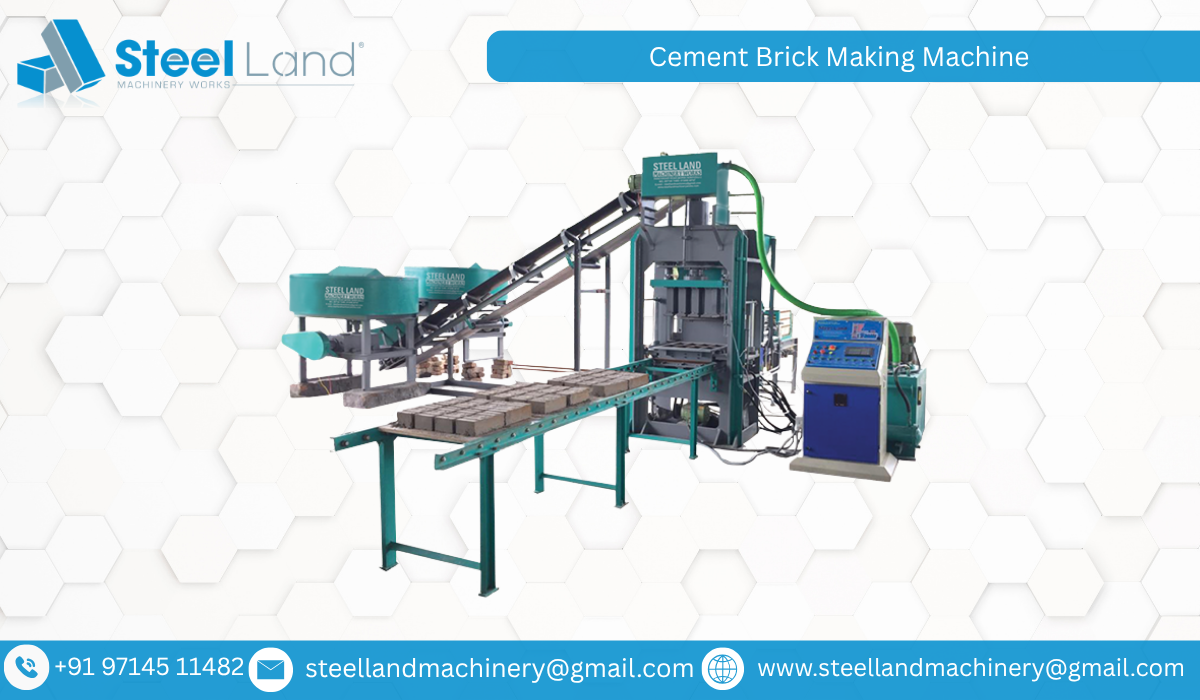
Cement Brick Making Machine: A Reliable Solution for Modern Brick Production
The construction industry is continuously moving toward faster, more consistent, and cost-effective methods of producing quality building materials. A Cement Brick Making Machine provides an efficient solution for manufacturing uniform cement-based bricks and blocks with controlled compaction, repeatable dimensions, and improved productivity. For businesses planning to establish or expand a brick manufacturing unit, selecting machinery with the right combination of automation, hydraulic pressure, vibration, moulding accuracy, and production capacity is essential.
Steel Land Machinery Works, based in Morbi, Gujarat, specializes in brick and block-making machinery designed for construction and infrastructure applications. The company offers automatic and customized machinery solutions with a focus on durability, productivity, operational efficiency, and long-term performance.
What Is a Cement Brick Making Machine?
A Cement Brick Making Machine is industrial equipment used to mould and compact a prepared mixture of cement, aggregates, sand, and other suitable materials into bricks or blocks of predetermined dimensions. Depending on the machine configuration, the production process can incorporate controlled feeding, mould filling, vibration, hydraulic pressing, demoulding, and pallet handling.
Modern machines combine vibration and pressure to achieve better material compaction. For example, Steel Land Machinery Works' automatic machinery uses PLC-controlled vibration and high-pressure technology, while its dual vibration and pressure-based compaction system is designed for consistent finished products.
Why Choose the Top Cement Brick Making Machine?
Choosing the Top Cement Brick Making Machine means looking beyond the initial purchase price. A production machine should be evaluated according to output requirements, automation level, mould configuration, power consumption, maintenance requirements, available floor space, and expected operating hours.
The Best Cement Brick Making Machine should provide a practical balance between production capacity and product quality. Consistent mould filling and controlled compaction help reduce variations in brick dimensions and density. Automation can also minimize repetitive manual work and improve production monitoring.
Steel Land Machinery Works provides different machine models and configurations so manufacturers can select equipment according to their production requirements. Its automatic SL-series machines, for example, feature cycle times in the range of approximately 15–25 seconds, with specifications varying by model.
Key Features
A professionally engineered Cement Brick Making Machine can offer several features that improve manufacturing efficiency:
- Hydraulic pressure system: Controlled pressure assists in producing densely compacted products.
- Vibration technology: Vibration helps distribute the concrete mix throughout the mould and improves compaction.
- PLC-based control: Automated controls provide better control over machine functions and production cycles.
- Robust construction: Heavy-duty steel structures and industrial components support continuous operation.
- Interchangeable moulds: Appropriate mould configurations can allow production of different brick or block designs.
- Automatic operation: Reduces dependency on manual processes and helps maintain repeatable production.
- Production monitoring: Automation and supporting systems can help operators track production and improve workflow.
Steel Land Machinery Works also provides optional batching and stacking systems. Its batching system is intended to improve raw-material proportioning and consistency, while the stacking system can reduce labour requirements and improve handling efficiency.
Technical Considerations Before Buying
When selecting a Cement Brick Making Machine, buyers should first determine the required production volume. A small manufacturing unit may require a compact or semi-automatic solution, while large contractors and commercial brick producers can benefit from automated high-output systems.
Important technical parameters include:
- Machine automation: Manual, semi-automatic, or automatic.
- Cycle time: Determines how quickly moulding operations can be repeated.
- Pallet dimensions: Must match the selected machine and production system.
- Hydraulic system: Pressure capability, oil capacity, and component quality are important.
- Vibration system: Proper vibration contributes to consistent compaction.
- Power requirement: Should be compatible with the available electrical infrastructure.
- Product height: The moulding range should accommodate the required brick or block dimensions.
- Installation area: Adequate space is required for the machine, raw-material handling, curing, and finished-product movement.
For instance, Steel Land Machinery Works lists an automatic SL 2100 model with a 610 × 610 mm pallet, 15–25 second cycle time, 24.5 HP power, 400-litre hydraulic oil capacity, and 50–200 mm finished-product height range. These specifications demonstrate why machine selection should be based on the complete production requirement rather than capacity alone.
Applications of Cement Brick Making Machine
The applications of a Cement Brick Making Machine extend across residential, commercial, industrial, and infrastructure construction. Manufactured bricks and blocks can be used for wall construction, partition work, boundary walls, warehouses, commercial buildings, housing projects, and other construction requirements, subject to the product design and applicable standards.
The machinery is particularly useful for:
- Brick and block manufacturing plants
- Real estate and residential projects
- Commercial construction
- Industrial construction
- Infrastructure development
- Building-material production businesses
- Contractors requiring regular quantities of concrete-based products
Cement Brick Making Machine Price: What Determines the Cost?
The Cement Brick Making Machine Price depends on several factors rather than one fixed figure. Machine capacity, automation level, hydraulic and vibration systems, mould configuration, batching and stacking options, electrical components, and customization can all influence the final investment.
Businesses comparing prices should therefore evaluate total operating value, including production consistency, labour requirements, maintenance, energy consumption, service support, and expected machine life. A lower initial price does not necessarily represent the lowest long-term production cost.
Why Steel Land Machinery Works?
Steel Land Machinery Works is an experienced Cement Brick Making Machine Manufacturer serving customers in India and international markets. The company operates from Morbi, Gujarat, and provides brick and block machinery backed by engineering expertise, installation assistance, training, and after-sales support.
As a Cement Brick Making Machine Supplier, Steel Land Machinery Works focuses on delivering machinery according to production requirements rather than using a one-size-fits-all approach. Its portfolio includes brick, paver block, hollow block, and solid block-making equipment.
The company also operates as a Cement Brick Making Machine Exporter, with its website stating that its machinery has been exported to more than 15 countries.
Cement Brick Making Machine in Gujarat and India
For businesses searching for a Cement Brick Making Machine in Gujarat, Morbi has become an important manufacturing location for construction machinery. Steel Land Machinery Works serves customers across Gujarat as well as other Indian markets.
Similarly, companies looking for a Cement Brick Making Machine in India can select machinery based on their desired production capacity, automation requirements, available infrastructure, and product specifications. With suitable equipment and a properly planned production workflow, manufacturers can build a scalable operation focused on consistent quality and productivity.
Conclusion
A modern Cement Brick Making Machine can transform brick manufacturing by combining controlled moulding, vibration, hydraulic compaction, automation, and efficient material handling. The right machine can help businesses achieve repeatable production, reduce manual dependency, and establish a more organized manufacturing process.
For businesses evaluating machinery for a new plant or upgrading an existing facility, Steel Land Machinery Works offers engineered brick and block-making solutions designed for diverse production requirements. Choosing the right configuration, mould, automation level, and supporting systems can make the investment more productive and sustainable over the long term.