Durability of Fly Ash Bricks: Strength, Lifespan, Water Resistance & Construction Performance
The demand for reliable and sustainable construction materials is increasing as builders look for products that combine strength, dimensional consistency, cost efficiency, and environmental benefits. Fly ash bricks have become an important alternative to conventional clay bricks because they can offer excellent mechanical performance when manufactured with the right raw materials, controlled compaction, and proper curing.
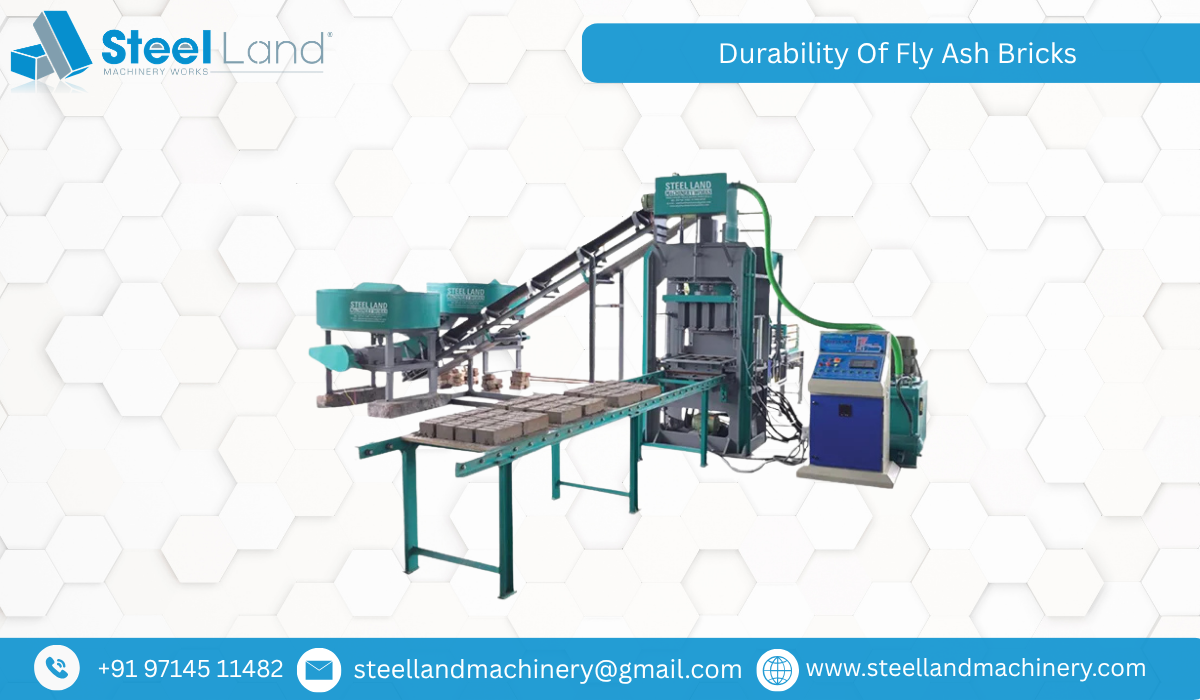
Understanding the Durability of Fly Ash Bricks is particularly important for builders, contractors, infrastructure developers, and brick manufacturers who want dependable masonry products. Steel Land Machinery Works manufactures advanced brick-making machinery designed to produce uniform, compact, and high-quality fly ash bricks for modern construction requirements. The company specializes in fly ash brick machines, paver block machines, hollow block machines, and solid block machines.
What Makes Fly Ash Bricks Durable?
The Fly Ash Brick Durability depends on several interconnected factors, including raw-material quality, mix proportion, compaction pressure, moisture control, curing, and manufacturing consistency. Fly ash is generally combined with materials such as sand, lime or cement, gypsum, and water according to the selected production process.
A properly manufactured brick has a dense and uniform structure, reducing internal voids and helping it withstand normal loads and environmental exposure. The manufacturing process is therefore just as important as the composition of the mixture.
Modern machinery helps achieve repeatable mould filling and compaction, which can contribute to consistent brick density and dimensions. Steel Land Machinery Works highlights consistent quality, controlled density, reduced labour requirements, and predictable production as benefits of its automated brick manufacturing systems.
Fly Ash Brick Strength and Durability
One of the most important factors determining service performance is compressive strength. Fly Ash Brick Compressive Strength is evaluated through standardized testing, and higher-strength classes are suitable for applications where greater load-bearing performance is required.
Under IS 12894, pulverized fuel ash-lime bricks are classified according to their average wet compressive strength. The standard also covers requirements related to dimensions, water absorption, drying shrinkage, and efflorescence.
This means High-Strength Fly Ash Bricks should not be judged simply by appearance. Laboratory testing and compliance with the applicable specification provide a more reliable indication of product quality.
How Long Do Fly Ash Bricks Last?
The Fly Ash Bricks Lifespan is influenced by brick quality, structural loading, exposure conditions, workmanship, mortar selection, and moisture management. Properly manufactured and correctly installed fly ash bricks can provide long-term service in suitable building applications.
Curing is particularly important. Indian Railways' technical information on fly ash bricks describes air drying followed by water curing for approximately 14–21 days, producing bricks described as sound, compact, and uniform in shape.
Therefore, durability should be considered as a complete production-and-construction process rather than a single property of the raw material.
Fly Ash Brick Water Resistance
Fly Ash Brick Water Resistance is another major consideration when selecting masonry materials. Excessive water absorption can contribute to moisture-related problems, while controlled absorption supports better performance in building applications.
IS 12894 specifies water absorption testing for pulverized fuel ash-lime bricks. The standard includes limits based on the brick's strength class, making water absorption an important quality-control parameter alongside compressive strength.
Proper compaction and curing can help create a denser brick structure. However, manufacturers should always test their finished products rather than assuming performance based only on the production method.
Features That Support Long-Lasting Fly Ash Bricks
A reliable fly ash brick production system should provide:
- Accurate raw-material proportioning
- Consistent mould filling
- Controlled hydraulic or mechanical compaction
- Effective vibration where applicable
- Uniform brick dimensions
- Repeatable production cycles
- Reduced human error
- Consistent product density
- Suitable mould configurations
- Easy production monitoring
Steel Land Machinery Works offers automatic brick machines with features focused on production capacity, consistent quality, reduced labour costs, and energy efficiency. Its listed machinery includes multiple production models for different output requirements.
Weather-Resistant Fly Ash Bricks for Construction
Weather-Resistant Fly Ash Bricks are useful in projects where masonry may experience changing temperature, humidity, rainfall, and other environmental conditions. However, weather resistance depends on the complete brick specification and construction system.
For outdoor or exposed applications, manufacturers should pay particular attention to water absorption, compressive strength, efflorescence, curing quality, and dimensional accuracy. Correct storage before installation and appropriate protection during construction can also help maintain brick quality.
Fly Ash Brick Quality Standards and Testing
Following Fly Ash Brick Quality Standards is essential for producing commercially reliable products. Important quality checks can include:
- Compressive strength
- Water absorption
- Dimensions and tolerances
- Drying shrinkage
- Efflorescence
- General appearance and soundness
BIS documentation for IS 12894 specifically identifies wet compressive strength, water absorption, drying shrinkage, efflorescence, dimensions, and general requirements as relevant testing or specification areas.
Manufacturers should therefore establish routine quality-control procedures and periodically test production batches.
Applications of Fly Ash Bricks
The combination of strength, uniformity, and sustainability makes Fly Ash Bricks for Construction suitable for a wide range of building applications, subject to project specifications and applicable standards.
Common applications include:
- Residential buildings
- Commercial buildings
- Industrial structures
- Warehouses
- Institutional buildings
- Boundary walls
- Partition walls
- Infrastructure projects
- Government construction projects
- Multi-storey building masonry
Indian Railways documentation also records fly ash brick use in townships, power plant construction, office buildings, educational facilities, and residential projects.
Fly Ash Brick Maintenance and Long-Term Performance
Proper Fly Ash Brick Maintenance begins with good construction practices. Bricks should be stored appropriately, protected from unnecessary contamination, and used with suitable mortar and workmanship. Finished masonry should be protected from prolonged uncontrolled moisture exposure during construction.
At the manufacturing stage, regular machine maintenance is equally important. Cleaning moulds, checking hydraulic components, inspecting vibration systems, maintaining electrical controls, and replacing worn parts can help maintain consistent production quality.
Fly Ash Brick Advantages for Modern Construction
The major Fly Ash Brick Advantages include consistent shape, potential for high strength, efficient utilization of fly ash, good dimensional uniformity, and suitability for large-scale automated production. Steel Land Machinery Works specifically identifies strength and durability, cost effectiveness, insulation, and environmental friendliness among the benefits associated with fly ash bricks.
For entrepreneurs, contractors, and manufacturers, investing in suitable machinery can make it easier to produce standardized bricks at commercial scale while controlling labour and production variables.
Choose a Reliable Fly Ash Brick Manufacturer in India
The quality of the finished brick starts with the production system. A dependable machine should provide stable compaction, consistent moulding, practical automation, and reliable operation. Steel Land Machinery Works is an experienced Fly Ash Brick Manufacturer in India and machinery specialist offering brick-making solutions designed around productivity, quality, and long-term industrial use.
For businesses planning a new fly ash brick plant or upgrading an existing production line, evaluating machine capacity, automation, mould configuration, raw-material handling, curing arrangements, and after-sales support can help create a more efficient manufacturing operation.
Ultimately, the Durability of Fly Ash Bricks is the result of quality materials, controlled manufacturing, proper compaction, adequate curing, standardized testing, and correct construction practices. By combining these factors with dependable brick-making machinery, manufacturers can produce consistent products capable of meeting the demanding requirements of modern construction.

 Solid Block Machine