Eco-Friendly Brick Making Process: A Sustainable Approach to Modern Brick Manufacturing
The construction industry is increasingly moving toward materials and production methods that combine strength, efficiency, and environmental responsibility. Traditional clay brick manufacturing can consume significant quantities of natural soil and energy, creating a need for better alternatives. The Eco-Friendly Brick Making Process offers a practical approach by utilizing materials such as fly ash and other suitable industrial by-products to manufacture durable construction bricks while reducing material waste. Steel Land Machinery Works, Morbi, Gujarat, manufactures advanced brick and block-making machinery designed to support efficient and environmentally responsible construction-material production.
What Is an Eco-Friendly Brick Making Process?
The Eco-Friendly Brick Making Process is a controlled manufacturing method in which selected raw materials are proportioned, mixed, compressed, moulded, and cured to produce uniform bricks. Depending on the brick type and formulation, materials may include fly ash, cement, sand, aggregates, lime, gypsum, and water.
Unlike conventional fired-clay brick production, fly ash-based manufacturing does not depend on firing every finished brick in a traditional kiln. Instead, mechanical pressure and controlled vibration are used to form bricks, followed by appropriate curing. This makes the process particularly relevant to businesses looking for resource-efficient construction-material manufacturing.
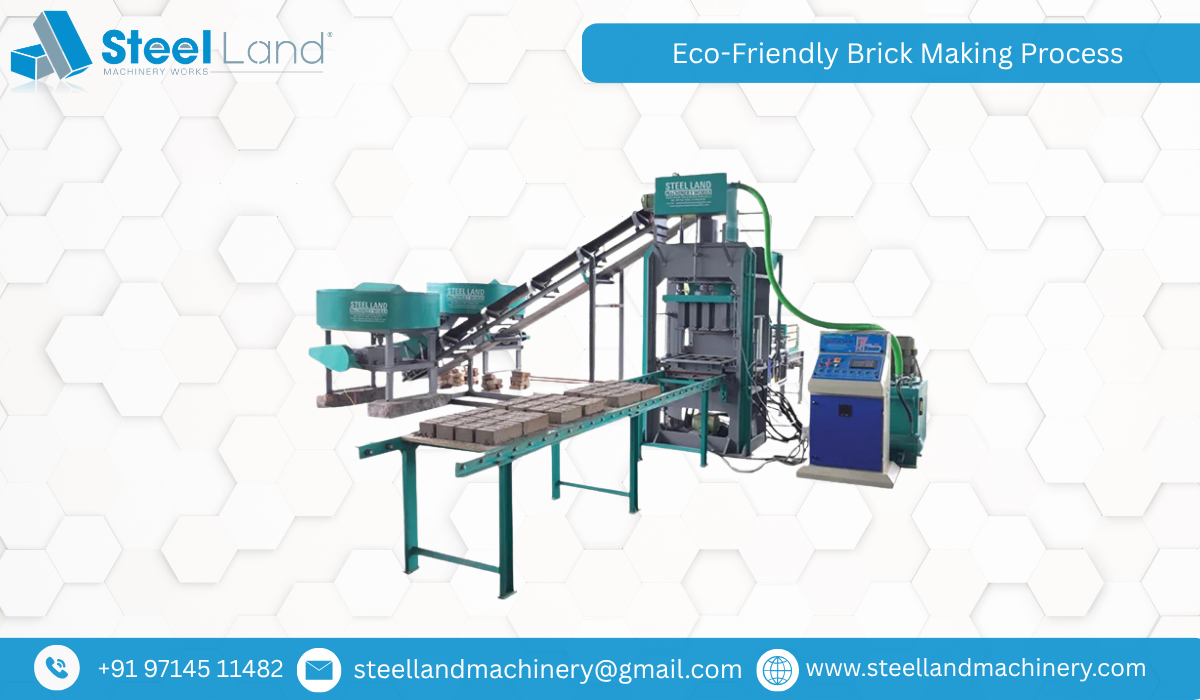
Steel Land Machinery Works offers fly ash brick machines in multiple configurations and production capacities, supporting different manufacturing requirements.
How the Sustainable Brick Manufacturing Process Works
A successful Sustainable Brick Manufacturing Process begins with proper raw-material selection and proportioning. The materials are first measured according to the required mix design. Accurate batching is important because variations in raw-material proportions can affect brick density, dimensional consistency, strength, and production stability.
The materials are then thoroughly mixed with controlled quantities of water. The prepared mixture is transferred into the brick-making machine, where mould filling, vibration, and hydraulic or mechanical compaction form the bricks.
After demoulding, the green bricks are carefully handled and placed in a suitable curing environment. Proper curing allows the binder to develop the required strength over time. Consequently, production quality depends not only on the machine but also on material preparation, compaction, handling, and curing practices.
Green Brick Making Process and Technology
The Green Brick Making Process focuses on improving resource utilization while maintaining dependable product quality. Fly ash is particularly important because it can be incorporated as a useful raw material instead of being treated only as an industrial waste material.
Modern machinery can further improve the process through automated controls, consistent material feeding, repeatable moulding cycles, and optimized compaction. Steel Land Machinery Works highlights automated machinery, high production capacity, consistent quality, reduced labour requirements, and energy efficiency as important benefits of its brick-making technology.
Key Features of Environment-Friendly Brick Production
Modern Environment-Friendly Brick Production equipment should provide a balance between productivity, precision, durability, and ease of operation. Important features include:
- Robust machine construction for continuous industrial operation
- Controlled hydraulic or mechanical pressure
- Vibration technology for effective material compaction
- Precision moulding for consistent brick dimensions
- Automated controls in advanced machine configurations
- Reduced dependence on manual production
- Efficient utilization of raw materials
- Compatibility with different mould configurations
- Easy maintenance and practical machine operation
- Support for high-volume production requirements
Steel Land Machinery Works also provides production equipment and accessories such as pan mixers and automatic vibrator machines to support an integrated manufacturing setup.
Eco-Friendly Bricks Manufacturing: Major Advantages
Eco-Friendly Bricks Manufacturing can offer several advantages for construction-material producers. The use of fly ash and other suitable materials can contribute to resource conservation and industrial waste utilization. Mechanized production also provides greater control over brick dimensions and production cycles compared with entirely manual methods.
Another advantage is scalability. Businesses can select machinery according to their desired production volume, available infrastructure, labour requirements, and future expansion plans. Steel Land Machinery Works manufactures fully automatic brick and block machinery for businesses with different production objectives.
Fly Ash Brick Making Process: Technical Considerations
The Fly Ash Brick Making Process requires careful control of raw materials, moisture content, mixing quality, mould filling, pressure, vibration, and curing. Fly ash generally needs to be blended with suitable binders and aggregates according to the desired product characteristics.
A consistent mixture improves mould filling and helps achieve repeatable brick density. During compaction, pressure and vibration help consolidate the material within the mould. The freshly manufactured bricks then require proper curing and handling to develop their intended performance.
Steel Land Machinery Works lists fly ash brick machine models ranging from SL 1600 through SL 5040, demonstrating its focus on machinery for varied production requirements.
Green Building Brick Manufacturing for Modern Projects
Green Building Brick Manufacturing is becoming increasingly relevant as builders, developers, and infrastructure companies look for construction products that support resource-efficient building practices. Bricks manufactured through controlled processes can be used in residential buildings, commercial projects, industrial structures, warehouses, boundary walls, and other masonry applications.
The objective is not simply to manufacture an environmentally preferable product but to create a production system that combines material efficiency, reliable machinery, consistent quality, and commercially viable output.
Sustainable Construction Bricks and Low Carbon Brick Production
The growing demand for Sustainable Construction Bricks is encouraging manufacturers to explore alternative raw materials and efficient production technologies. Properly designed production systems can minimize avoidable material losses and reduce dependence on conventional fired-clay manufacturing.
Similarly, Low Carbon Brick Production emphasizes reducing unnecessary energy use, improving material utilization, and selecting production methods with a lower environmental impact. The actual environmental performance depends on raw materials, energy sources, transportation, mix design, curing methods, and the complete manufacturing system, so these factors should be evaluated together.
Applications of Eco-Friendly Bricks
Bricks produced through an Eco-Friendly Brick Making Process can be suitable for:
- Residential construction
- Commercial buildings
- Industrial facilities
- Warehouses and factories
- Boundary walls
- Partition walls
- Infrastructure projects
- Institutional buildings
- General masonry applications
Their consistent dimensions and machine-controlled production make them suitable for manufacturers supplying bricks to a wide range of construction projects.
Eco-Friendly Brick Making Machine from Steel Land Machinery Works
An Eco-Friendly Brick Making Machine is the foundation of a reliable sustainable brick production line. Steel Land Machinery Works, based in Morbi, Gujarat, specializes in brick and block-making machinery, including fly ash brick machines, fully automatic paver block machines, hollow block machines, and solid block machines. The company also emphasizes in-house production, innovative technology, high output, low maintenance, and after-sales support.
For manufacturers planning to establish or expand a sustainable brick plant, machine selection should be based on required output, brick dimensions, automation level, raw-material availability, plant layout, power requirements, and curing capacity.
The Eco-Friendly Brick Making Process represents a practical direction for modern construction-material manufacturing. By combining suitable alternative raw materials with accurate batching, effective mixing, controlled compaction, and proper curing, manufacturers can build an efficient production system focused on consistency and responsible resource utilization. With suitable machinery from Steel Land Machinery Works, businesses can develop scalable brick-production operations aligned with the growing demand for sustainable construction solutions.