Fly Ash Bricks Vs Red Clay Bricks: Which Is Better for Construction?
Choosing the right brick is an important decision for any residential, commercial, or infrastructure project. Bricks influence wall strength, durability, workmanship, material consumption, and overall construction efficiency. Two commonly considered options are fly ash bricks and traditional red clay bricks. Understanding their technical characteristics makes it easier for builders, contractors, architects, and manufacturers to select the appropriate masonry unit.
This detailed Fly Ash Bricks vs Red Clay Bricks comparison explains their composition, manufacturing process, strength, water absorption, dimensional characteristics, applications, and cost considerations. Steel Land Machinery Works provides brick-making machinery designed to support modern brick manufacturing requirements, including hydraulic and automated production solutions.
What Are Fly Ash Bricks?
Fly ash bricks are manufactured using fly ash along with suitable binding and aggregate materials, depending on the specific brick formulation. Unlike conventional burnt clay bricks, many fly ash-based bricks are formed through mechanical or hydraulic compaction rather than relying on the traditional clay-firing process.
The manufacturing process generally involves proportioning raw materials, mixing, feeding the mixture into moulds, applying controlled pressure, removing the formed bricks, and curing them under appropriate conditions. Consistency in raw-material proportioning, moisture, pressure, curing, and quality control has a direct effect on the finished product.
BIS recognizes specifications for pulverized fuel ash-lime bricks and also maintains standards relating to burnt clay fly ash building bricks, with testing covering properties such as compressive strength and water absorption.
What Are Red Clay Bricks?
Red clay bricks are traditional masonry units produced primarily from suitable clay or earth-based raw materials. The material is shaped into bricks and then dried and fired in a kiln. The firing process develops the characteristic red or reddish-brown appearance and gives the brick its final physical properties.
Traditional clay bricks remain widely used because of their familiar construction practices, availability, appearance, and established use in masonry. BIS identifies common burnt clay building bricks under IS 1077, with different class designations based on specified requirements.
Difference Between Fly Ash Bricks and Red Clay Bricks
The Difference Between Fly Ash Bricks and Red Clay Bricks begins with their raw materials and manufacturing technology. Fly ash bricks use industrial by-product material as a major component and are generally manufactured through controlled mixing, moulding, pressing, and curing. Red clay bricks use clay-based raw materials and require kiln firing.
Another significant difference is dimensional consistency. Mechanically moulded fly ash bricks can provide uniform shapes when the raw material and production parameters are properly controlled. Traditional clay bricks can show variations depending on moulding, drying, firing conditions, and production practices.
The correct comparison should always consider tested product data rather than assumptions based solely on brick type.
Fly Ash Bricks Vs Clay Bricks Comparison: Key Factors
A practical Fly Ash Bricks vs Clay Bricks Comparison should consider several factors:
| Property | Fly Ash Bricks | Red Clay Bricks |
|---|---|---|
| Main raw material | Fly ash with suitable binders/aggregates | Clay-based material |
| Manufacturing | Mixing, moulding, pressing and curing | Moulding, drying and kiln firing |
| Appearance | Generally uniform grey finish | Typically reddish appearance |
| Dimensional consistency | Can be highly consistent with controlled production | Depends on moulding and firing |
| Strength | Depends on formulation, curing and grade | Depends on clay quality and firing |
| Water absorption | Must be verified through testing | Must be verified through testing |
| Applications | Masonry, partitions and construction products | Masonry, walls and traditional construction |
| Quality control | Pressure, mix and curing are important | Drying and firing are critical |
BIS testing frameworks specifically include compressive strength and water absorption for relevant brick categories, making laboratory testing important when comparing products.
Fly Ash Brick Strength Vs Red Clay Brick Strength
Fly Ash Brick Strength vs Red Clay Brick Strength should not be judged simply by saying that one material is always stronger. Strength varies according to the grade, composition, manufacturing process, curing, firing conditions, and quality control.
Properly manufactured fly ash bricks can achieve specified strength levels suitable for their intended applications. Similarly, quality red clay bricks can provide dependable compressive strength when manufactured and fired correctly.
For construction projects, buyers should request test results and select bricks according to the structural and masonry requirements of the project. BIS testing references include compressive-strength determination for both relevant fly ash and burnt-clay brick categories.
Fly Ash Bricks Benefits
The major Fly Ash Bricks Benefits include uniform moulding, controlled manufacturing, utilization of fly ash, and potential for efficient large-scale production. Their relatively consistent dimensions can also support systematic masonry work and potentially reduce variations in mortar joints.
Another important benefit is manufacturing efficiency. With suitable machinery, producers can establish repeatable processes for mixing, pressing, demoulding, and curing. This makes hydraulic brick-making technology attractive for businesses seeking standardized construction products.
Red Clay Bricks Advantages
The Red Clay Bricks Advantages include their long-established acceptance in conventional construction, familiar installation practices, natural appearance, and broad availability in many markets. They are widely recognized by masons and contractors and have a long history of use in residential and commercial buildings.
However, quality varies according to the source of clay, moulding method, drying conditions, kiln temperature, and firing control. Therefore, product testing and proper selection remain essential.
Fly Ash Bricks Price Vs Red Clay Bricks Price
The Fly Ash Bricks Price vs Red Clay Bricks Price comparison depends on location, raw-material availability, production scale, transportation, labour, energy requirements, machine investment, and product quality.
A lower purchase price does not necessarily mean lower total construction cost. Dimensional consistency, breakage, mortar consumption, transportation distance, and availability can all influence the final economics. Manufacturers should therefore evaluate production and lifecycle factors instead of comparing only the per-brick purchase price.
Applications of Fly Ash Bricks for Construction
Fly Ash Bricks for Construction can be considered for residential buildings, commercial structures, partition walls, boundary walls, institutional projects, and other masonry applications where the selected brick meets the project's technical requirements.
The suitability of a particular brick should be confirmed according to structural design, local building requirements, environmental exposure, and relevant specifications.
Applications of Red Clay Bricks for Construction
Red Clay Bricks for Construction remain suitable for many conventional masonry applications, including residential walls, commercial buildings, partitions, boundary structures, and other projects where approved clay bricks meet the required specifications.
Selection should consider strength, water absorption, dimensions, efflorescence, durability, and workmanship rather than colour alone. BIS identifies testing procedures for burnt clay bricks covering properties such as compressive strength, water absorption, efflorescence, and warpage.
Choosing the Right Brick-Making Technology
For businesses planning to manufacture modern construction bricks, machinery selection is equally important. A reliable production system should provide controlled material feeding, effective mixing, accurate mould filling, consistent hydraulic pressure, and suitable curing arrangements.
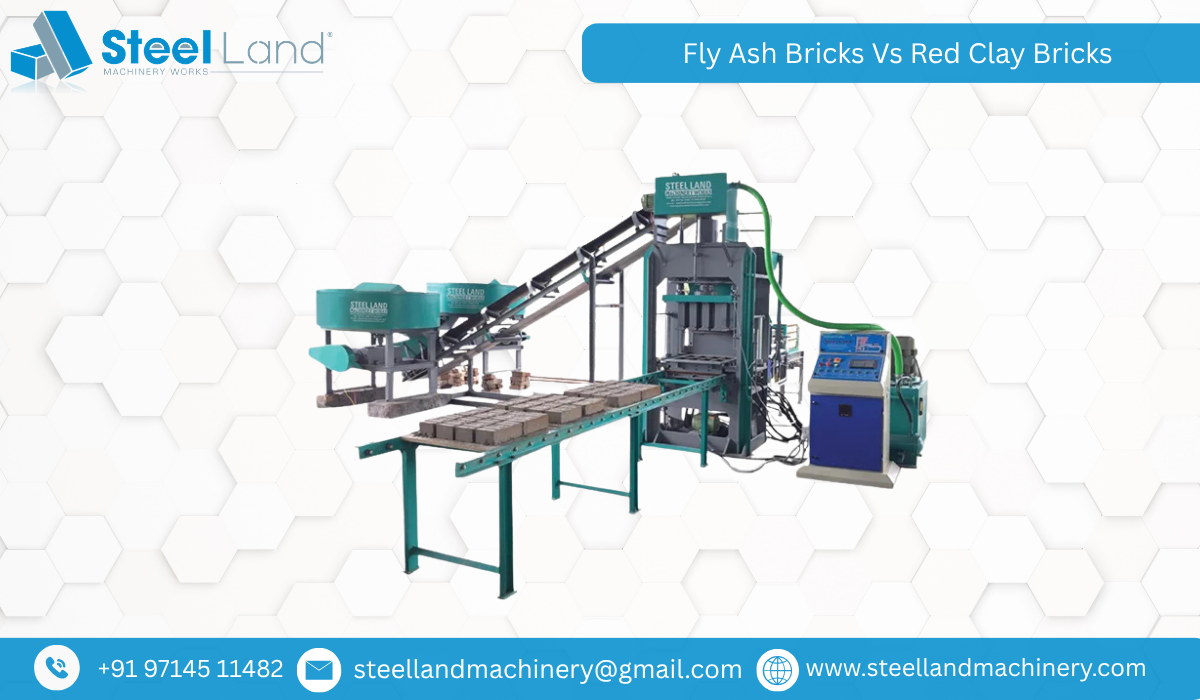
Steel Land Machinery Works develops brick and block-making machinery for manufacturers seeking dependable production systems. A properly selected machine can help manufacturers establish consistent production while adapting mould configurations and operating parameters to their product requirements.
Conclusion
The Fly Ash Bricks vs Red Clay Bricks decision ultimately depends on project requirements, local availability, product specifications, manufacturing quality, and tested performance. Fly ash bricks can offer controlled dimensions and efficient mechanized production, while red clay bricks continue to provide a familiar and widely used traditional masonry solution.
For manufacturers interested in producing quality bricks at commercial scale, choosing suitable machinery, maintaining accurate raw-material proportions, controlling pressing or firing conditions, and implementing regular quality testing are essential. Steel Land Machinery Works provides brick-making machinery solutions designed to support modern construction-material manufacturing with reliable engineering and practical production technology.