Government Subsidy for Fly Ash Brick Plant in India: Schemes, Loans, Eligibility and Business Benefits
Starting a fly ash brick manufacturing unit can be an attractive opportunity for entrepreneurs looking to enter the construction-material industry with a product based on industrial by-product utilization. However, one of the most common questions is whether the government provides a direct subsidy specifically for a fly ash brick plant. The answer requires some clarification: there is no single universal central subsidy applicable to every fly ash brick factory. Instead, eligible entrepreneurs may explore government-backed MSME schemes, credit support, state-level incentives and financing programmes, depending on their location, business structure and project eligibility.
The Government Subsidy for Fly Ash Brick Plant in India is therefore best understood as a combination of applicable entrepreneurship, MSME financing and incentive opportunities rather than one fixed payment available to every applicant.
Is There a Government Subsidy for a Fly Ash Brick Plant?
A major route entrepreneurs can investigate is the Prime Minister’s Employment Generation Programme (PMEGP), which provides margin-money subsidy for eligible new micro-enterprises. Under PMEGP, subsidy rates depend on beneficiary category and whether the unit is established in an urban or rural area. The official PMEGP framework provides different subsidy rates for general and special-category applicants, while the remaining project finance can be arranged through participating banks.
This means an entrepreneur should not assume a fixed percentage of subsidy simply because the proposed business manufactures fly ash bricks. Eligibility, project cost, applicant category, location and scheme rules must be checked before preparing the application.
Understanding Fly Ash Brick Plant Subsidy in India
The Fly Ash Brick Plant Subsidy in India can involve several components depending on the applicant's circumstances. These may include margin-money assistance under an eligible government programme, bank finance, credit guarantees and applicable state incentives.
Another important development is the government's policy encouraging productive utilization of fly ash. The Ministry of Power has issued procedures for supplying fly ash to Micro and Small Enterprises and local users engaged in ash-based product manufacturing. Under the January 2026 procedure, thermal power plants are required to reserve a certain quantity for eligible MSEs and local users at concessional rates, subject to the prescribed process and eligibility conditions.
Therefore, entrepreneurs should consider both financial assistance and fly ash availability when planning a manufacturing project.
Government Scheme for Fly Ash Brick Plant
A Government Scheme for Fly Ash Brick Plant should be selected according to the project's financial requirements rather than simply its product name. PMEGP is particularly relevant to new micro-enterprise projects, subject to its eligibility and current guidelines. The official PMEGP portal states that assistance is intended for new projects sanctioned specifically under the programme.
Entrepreneurs should prepare a detailed project report covering machinery, land or shed requirements, electrical installation, raw materials, labour, working capital, expected production, sales projections and repayment capacity. A technically sound project report can help the lending institution evaluate the commercial viability of the proposed unit.
Fly Ash Brick Manufacturing Subsidy: What to Prepare
Before applying for Fly Ash Brick Manufacturing Subsidy, applicants should generally organize documents and technical information such as:
- Aadhaar and PAN details
- Business registration and Udyam registration, where applicable
- Detailed project report
- Machinery quotations
- Land or shed documents
- Bank account and financial information
- Raw-material availability plan
- Estimated production capacity
- Projected sales and profitability
- Working-capital requirement
- Electricity and utility requirements
- Applicable pollution-control or local statutory approvals
Requirements can vary according to the scheme, lender and state. Applicants should verify the latest conditions with the concerned implementing agency and bank before committing funds.
Fly Ash Brick Plant Loan Scheme and Credit Support
A Fly Ash Brick Plant Loan Scheme may involve term finance for machinery and infrastructure together with working-capital finance for cement, fly ash, aggregates, labour, electricity, transportation and other operating expenses.
Entrepreneurs can also investigate CGTMSE-backed credit where eligible. CGTMSE does not itself provide a loan or subsidy; instead, it provides guarantee support to eligible lending institutions for qualifying MSE credit facilities. Its current scheme provides guarantee coverage for eligible credit facilities up to ₹10 crore per borrower through specified member lending institutions, subject to scheme conditions.
This distinction is important: CGTMSE is a credit guarantee mechanism, not a direct Government grant.
Fly Ash Brick Plant Government Grant: Is It Guaranteed?
A Fly Ash Brick Plant Government Grant should never be treated as guaranteed simply because a project uses fly ash. Government assistance is normally conditional on scheme eligibility, application approval, project viability and compliance with applicable rules.
For this reason, entrepreneurs should avoid websites or agents promising a guaranteed subsidy percentage without checking the official scheme guidelines. The actual benefit may depend on the programme, applicant category, project location and sanctioned project structure.
Machinery Selection and Technical Features
The financial plan is only one part of a successful fly ash brick project. Machinery selection directly influences production consistency, labour requirements and operating efficiency.
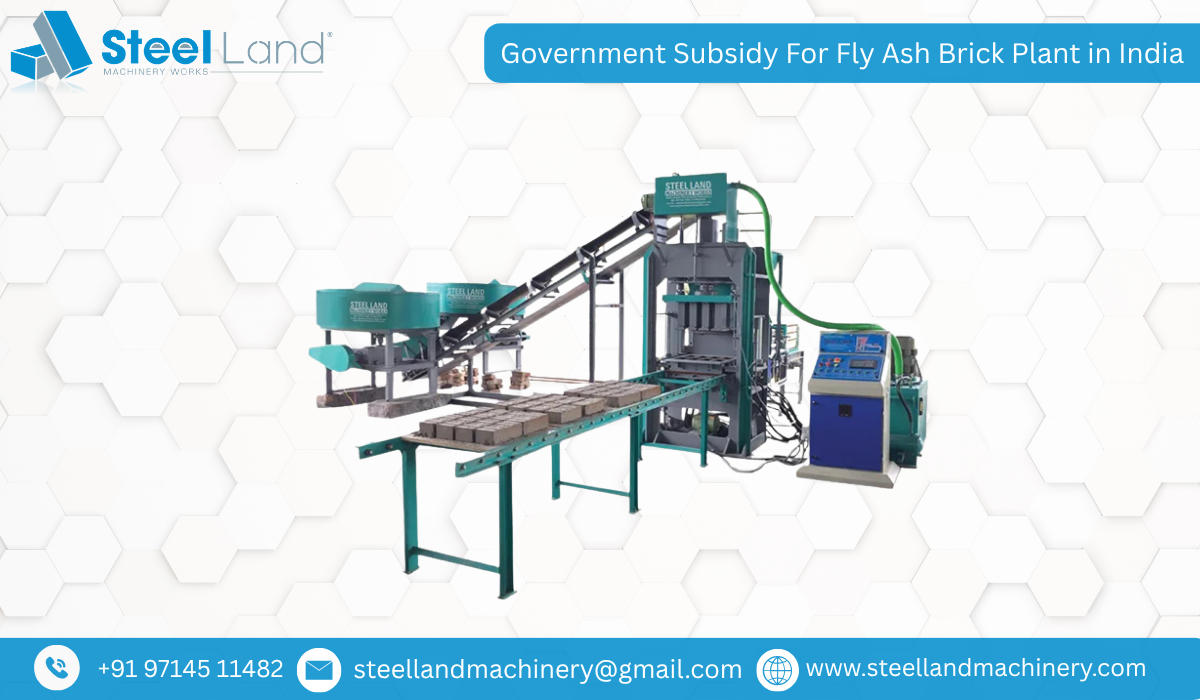
A modern fly ash brick plant can include a hydraulic brick-making machine, pan mixer or suitable mixing system, material-handling equipment, moulds, pallets and curing arrangements. Depending on the selected configuration, automation can reduce manual intervention and provide more consistent production cycles.
Important machinery considerations include:
- Hydraulic or mechanical compaction system
- Suitable mould configuration
- Consistent material feeding
- Controlled vibration where applicable
- Strong machine frame
- PLC-based automation on suitable models
- Easy mould changeover
- Production monitoring
- Low-maintenance components
- Compatibility with the planned brick dimensions
Steel Land Machinery Works manufactures and supplies brick and block-making machinery for entrepreneurs establishing or expanding construction-material production facilities.
Applications of Fly Ash Bricks
Fly ash bricks are used in numerous construction applications, including:
- Residential buildings
- Commercial projects
- Industrial buildings
- Warehouses
- Boundary walls
- Institutional construction
- Infrastructure projects
- Real-estate developments
- Masonry and partition work
Their growing use is supported by the broader objective of utilizing fly ash in construction products and reducing dependence on conventional materials.
How to Plan Your Project
Before applying for assistance, calculate the complete investment rather than considering only the brick machine. Include machinery, moulds, mixer, pallets, electrical installation, shed, transportation, labour, raw materials, curing arrangements and working capital.
The Subsidy for Fly Ash Brick Machine may also differ from the overall financial assistance available for establishing the complete manufacturing unit. A machinery quotation should therefore be incorporated into a complete project report rather than treated as the entire project cost.
Similarly, entrepreneurs researching Fly Ash Brick Business Subsidy in India should compare PMEGP, applicable MSME credit support and state-specific incentives instead of relying on a single subsidy claim.
Why Choose Steel Land Machinery Works?
Steel Land Machinery Works provides brick and block-making machinery designed for commercial construction-material production. Choosing the appropriate machine depends on required output, product dimensions, automation level, available infrastructure and investment capacity.
For entrepreneurs planning a new fly ash brick unit, the right machinery supplier can assist with understanding machine configurations, production requirements and equipment selection. The objective should be to build a technically practical plant that can operate efficiently after financing or subsidy approval.
Conclusion
The Government Subsidy for Fly Ash Brick Plant in India is not one universal subsidy available automatically to every entrepreneur. Instead, eligible businesses should investigate programmes such as PMEGP, suitable MSME credit facilities, CGTMSE-backed lending where applicable, state incentives and current fly-ash supply provisions.
A successful project begins with a realistic business plan, technically appropriate machinery, reliable raw-material sourcing and accurate financial projections. By combining these elements with verified government schemes and professional machinery support, entrepreneurs can create a more practical and sustainable fly ash brick manufacturing business in India.