Paver Block Manufacturing Process – Complete Guide to Making Quality Concrete Paver Blocks
The demand for durable and attractive paving solutions is growing rapidly across residential, commercial, industrial, landscaping, and infrastructure projects. Concrete paver blocks are widely preferred because they offer strength, design flexibility, easy installation, and convenient maintenance. However, producing consistent pavers requires proper material selection, accurate mixing, effective compaction, suitable moulds, and controlled curing. Understanding the Paver Block Manufacturing Process is therefore essential for manufacturers who want to achieve reliable quality and commercial production efficiency.
Steel Land Machinery Works, Morbi, Gujarat, specializes in construction machinery, including fully automatic paver block-making machines. Its machine range is designed to support consistent production while reducing manual intervention and improving operational efficiency.
What Is the Paver Block Manufacturing Process?
The Paver Block Manufacturing Process is a systematic method of converting cement, aggregates, pigments or other suitable materials into compact, dimensionally consistent paving blocks. The process generally involves raw-material selection, batching, mixing, mould filling, vibration and compaction, demoulding, curing, and quality inspection.
The quality of the finished paver depends on every stage. Incorrect material proportions can affect strength, while insufficient mixing or compaction can create weak spots and dimensional inconsistencies. A properly designed production system helps manufacturers maintain repeatability from one production cycle to the next.
Paver Block Raw Materials
The first stage is selecting suitable Paver Block Raw Materials. Depending on the required block specification, common materials include cement, fine aggregates, coarse aggregates, water, mineral pigments for coloured pavers, and selected admixtures where required.
Aggregate grading is particularly important because the particle-size distribution influences workability, compaction, surface finish, and final density. Materials should be clean and appropriately stored to prevent unwanted moisture variation or contamination.
Paver Block Mixing Process
The Paver Block Mixing Process begins with accurate batching of the required ingredients. Consistent proportioning is important because variations in cement, aggregate, water, or pigment content can affect the final product.
A suitable pan mixer or equivalent industrial mixer can provide more uniform blending than manual mixing. Steel Land Machinery Works lists pan mixers among the supporting equipment used with block-manufacturing systems.
The objective is to achieve a homogeneous mixture with suitable workability for mould filling and vibration compaction. Excess water should be avoided because the concrete mix must provide sufficient green strength for handling after moulding.
Paver Block Manufacturing Steps
The main Paver Block Manufacturing Steps can be summarized as follows:
- Material preparation: Cement, aggregates, pigments, and other ingredients are prepared according to the required formulation.
- Batching: Materials are measured in controlled proportions.
- Mixing: Ingredients are blended until a consistent mixture is obtained.
- Mould filling: The prepared mixture is fed into the selected paver mould.
- Vibration and compaction: Mechanical vibration and pressure compact the material and help remove entrapped air.
- Demoulding: The newly formed pavers are carefully removed from the mould.
- Curing: Fresh blocks are kept under suitable curing conditions to develop strength.
- Inspection: Finished products are checked for dimensions, appearance, edges, and other applicable quality requirements.
This sequence provides a repeatable manufacturing framework for both small and large production facilities.
How to Make Paver Blocks Using a Machine?
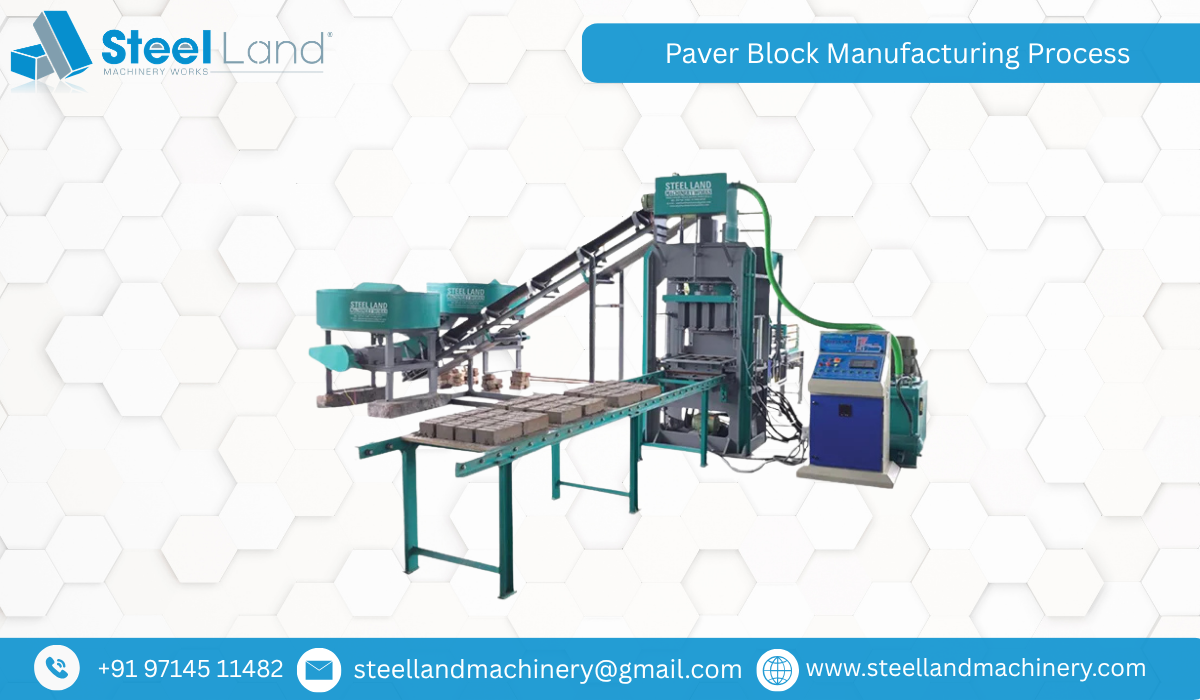
For businesses asking How to Make Paver Blocks, mechanized production provides better control over moulding and compaction. After the concrete mixture is prepared, it is transferred to the machine's moulding section. The mould determines the shape and dimensions of the paver.
The machine then uses vibration and compaction to consolidate the mix. Effective vibration helps distribute material throughout the mould and reduces voids. Depending on the machine configuration, several blocks can be produced during one stroke. Steel Land Machinery Works publishes different production configurations for zigzag, I-shape, and brick-shape pavers, with output varying according to mould design and machine model.
Paver Block Machine Process
The Paver Block Machine Process is centered on accurate mould filling followed by controlled vibration and compaction. This is one of the most important stages because the density achieved during moulding directly influences the quality and consistency of the green block.
Modern automated systems can reduce repetitive manual operations and provide more consistent production. Steel Land Machinery Works offers automatic and semi-automatic paver block machine solutions, allowing manufacturers to select equipment according to production scale and operational requirements.
Paver Block Production Line
A complete Paver Block Production Line may include aggregate storage, batching equipment, mixers, paver block machines, moulds, material-handling systems, curing arrangements, and finished-product storage.
The appropriate line configuration depends on daily production targets, available floor space, product designs, labour availability, automation level, and budget. A properly planned layout can reduce unnecessary material movement and improve workflow between mixing, moulding, curing, and storage areas.
Paver Block Manufacturing Plant Process
The Paver Block Manufacturing Plant Process should be designed around consistent material flow and quality control. Raw materials are stored and proportioned before entering the mixing section. The concrete then moves to the moulding machine, where pressure and vibration create the required block profile.
After demoulding, the green pavers require appropriate curing before being moved into final storage. Curing is essential for developing the required concrete strength and durability. The exact curing method and duration should be selected according to the concrete formulation, environmental conditions, product requirements, and applicable standards.
Features of a Modern Paver Block Manufacturing System
A well-designed production setup can offer:
- Consistent paver dimensions and shapes
- Controlled material batching
- Effective vibration compaction
- Interchangeable mould options
- Reduced repetitive manual work
- Improved production consistency
- Support for coloured and non-coloured pavers
- Scalable production capacity
- Better control over material usage
- Suitable configurations for different business sizes
Steel Land Machinery Works provides several paver machine models, including SL 1600, SL 2100, SL 2500, SL 2900, SL 3780, SL 4032, and SL 5040.
Applications of Concrete Paver Blocks
Concrete Paver Block Manufacturing supports the production of paving products used in numerous applications, including:
- Residential driveways
- Footpaths and walkways
- Parking areas
- Garden pathways
- Commercial premises
- Industrial yards
- Warehouses
- Roadside paving
- Institutional campuses
- Landscaping projects
- Outdoor public spaces
The interlocking design and modular nature of pavers make them practical for projects where individual sections may need replacement or maintenance.
Benefits of a Mechanized Paver Production System
The major advantage of mechanized production is consistency. Once the machine, mould, mix design, and operating parameters are properly established, manufacturers can produce repeated batches with controlled dimensions and compaction.
Automation can also improve productivity and reduce dependence on manual handling. Steel Land Machinery Works highlights increased production capacity, consistent quality, reduced labour requirements, and improved operational efficiency as advantages associated with automated block-making systems.
Why Choose Steel Land Machinery Works?
Steel Land Machinery Works is a Morbi-based manufacturer of construction machinery, serving customers across India and international markets. Its product portfolio includes paver block, hollow block, solid block, and fly ash brick-making machinery. The company also provides installation, training, plant-layout guidance, and after-sales support.
For manufacturers planning a new production unit or upgrading an existing facility, selecting the right machine should involve evaluating required output, paver designs, mould requirements, automation, available space, power requirements, maintenance, and technical support.
A properly planned Paver Block Manufacturing Process combines accurate raw-material preparation, controlled mixing, efficient moulding, vibration compaction, careful demoulding, and appropriate curing. With suitable machinery and production planning, manufacturers can establish a dependable paving-block operation capable of serving residential, commercial, and infrastructure markets.