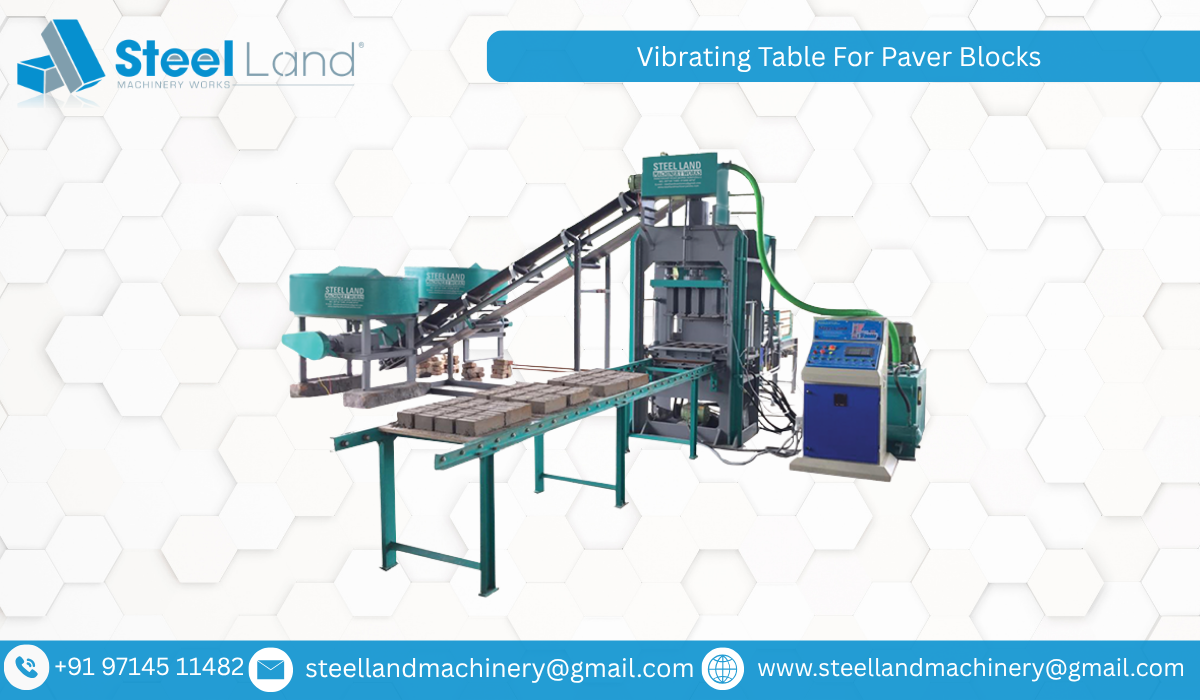
Vibrating Table For Paver Blocks – Efficient Compaction for High-Quality Paver Production
The quality of a paver block depends not only on the concrete mix but also on how effectively the material is compacted inside the mould. Proper vibration helps remove trapped air, distribute the concrete uniformly, and achieve a dense, consistent product. This is where a Vibrating Table For Paver Blocks becomes an important part of a modern paver manufacturing setup. Designed for controlled mechanical vibration, the equipment helps manufacturers produce paver blocks with better surface finish, uniform density, and consistent dimensions.
Steel Land Machinery Works, based in Morbi, Gujarat, specializes in construction machinery including paver block machines, vibrating equipment, brick machines, and block-making solutions. The company focuses on durable, reliable, and cost-effective machinery for construction-product manufacturers across India and international markets.
What Is a Vibrating Table For Paver Blocks?
A vibrating table is a rigid working platform fitted with a vibration mechanism, generally driven by an electric motor. Concrete-filled moulds are positioned on the table, and controlled vibration causes the mixture to settle and compact. This process helps minimize voids and improves contact between cement, sand, aggregates, pigments, and water within the mould.
A properly designed Vibrating Table For Paver Blocks can be used for different mould sizes and concrete products depending on the table dimensions, motor configuration, load capacity, and production requirements. The vibration intensity and operating cycle should be selected according to the material mix and mould characteristics rather than simply maximizing vibration.
How Does the Vibrating Table Work?
The operating process is straightforward but technically important:
- Prepare the required concrete mixture using the specified proportions of cement, aggregates, sand, pigments, and water.
- Fill the paver moulds with the prepared material.
- Place the moulds securely on the vibrating platform.
- Start the vibration system for the required cycle.
- Mechanical vibration causes the material to settle evenly and reduces entrapped air.
- Stop the machine, remove the moulds, and transfer the compacted products for demoulding and curing.
The objective is controlled and uniform compaction. Excessive vibration can affect certain mixes, while insufficient vibration may leave unwanted voids. Therefore, machine settings and operating procedures should be matched to the product being manufactured.
Key Features
A reliable Vibrating Table For Paver Blocks can offer several practical advantages for paver manufacturers:
- Robust steel construction: A strong fabricated frame supports repeated industrial operation.
- Efficient vibration mechanism: The vibration system promotes consistent material settlement.
- Uniform compaction: Helps achieve more consistent density throughout the mould.
- Improved surface finish: Proper compaction can reduce surface imperfections and improve appearance.
- Stable working platform: A rigid table provides dependable support for moulds during operation.
- Easy operation: Straightforward controls make the equipment suitable for regular production environments.
- Low-maintenance design: Durable mechanical and electrical components can help reduce downtime when properly maintained.
- Flexible application: Suitable configurations can support paver blocks, tiles, kerb-related products, and other concrete moulding applications.
Benefits for Paver Block Manufacturers
Investing in a suitable vibrating system can improve several stages of production. Consistent vibration helps manufacturers achieve repeatable compaction, which is important when producing large quantities of paver blocks with similar dimensions and finish.
A Vibrating Table For Paver Blocks can also help reduce manual compaction work. Instead of relying entirely on workers to compact each mould, mechanical vibration provides a more repeatable process. Better material settlement can contribute to improved product consistency and potentially lower rejection caused by visible voids or uneven compaction.
For businesses expanding their production capacity, the equipment can also work alongside pan mixers, paver moulds, automatic or semi-automatic paver machines, and curing arrangements to create a more organized production workflow.
Applications
The equipment is primarily used for manufacturing and compacting concrete products such as:
- Interlocking paver blocks
- Designer paver blocks
- Concrete tiles
- Garden and walkway tiles
- Kerb-related concrete products
- Decorative concrete products
- Landscaping products
- Flooring components
- Small precast concrete products
The exact application depends on the table design, mould dimensions, material characteristics, and required production method.
Choosing the Right Vibrating Table
Before purchasing equipment, manufacturers should evaluate table size, permissible load, motor power, vibration characteristics, frame construction, electrical requirements, and expected production volume. The mould dimensions should also be considered because the working platform needs to provide stable and adequate support.
It is equally important to discuss the intended concrete mix and product dimensions with the manufacturer. A properly matched vibration system can deliver better performance than selecting equipment solely on motor size or price.
Why Choose Steel Land Machinery Works?
Steel Land Machinery Works has developed construction machinery for manufacturers seeking practical and dependable production solutions. Its product range includes paver block machines and vibrating equipment, with support for customers across Gujarat, India, and overseas markets. The company's existing paver vibrating table offering is specifically positioned for uniform vibration and compaction during paver block production.
As a Vibrating Table Manufacturer For Paver Blocks, Steel Land Machinery Works emphasizes robust construction, consistent performance, and application-oriented machinery. The company also provides technical assistance to help customers select equipment according to their production requirements.
For businesses comparing a Vibrating Table Supplier For Paver Blocks, factors such as machine construction, service support, spare-part availability, operating requirements, and customization options should be considered alongside the initial investment.
Vibrating Table For Paver Blocks in Gujarat and India
Gujarat has a strong manufacturing ecosystem, making efficient construction machinery increasingly important for businesses involved in concrete-product production. A Vibrating Table For Paver Blocks in Gujarat can support manufacturers looking to improve compaction and production consistency.
Likewise, the growing construction and infrastructure sector creates opportunities for a Vibrating Table For Paver Blocks in India, particularly among small, medium, and large paver manufacturing units. Steel Land Machinery Works operates from Morbi, Gujarat, and serves customers across multiple Indian markets.
Understanding Vibrating Table Price For Paver Blocks
The Vibrating Table Price For Paver Blocks varies according to factors such as platform dimensions, motor specifications, load capacity, construction quality, vibration system, customization, and automation level. Buyers should compare total value rather than selecting equipment only according to the lowest quoted price.
For customers seeking an export-oriented solution, Steel Land Machinery Works also operates as a Vibrating Table Exporter For Paver Blocks, supporting businesses that require construction machinery for markets beyond India.
Conclusion
Consistent compaction is fundamental to producing reliable and visually uniform concrete pavers. A properly engineered Vibrating Table For Paver Blocks provides controlled mechanical vibration that helps settle concrete effectively, improve mould filling, and support repeatable production.
For manufacturers evaluating machinery for a new paver unit or upgrading an existing setup, Steel Land Machinery Works offers application-focused solutions backed by its experience in construction machinery manufacturing. Selecting the right vibrating table according to product, mould, load, and production requirements can create a more efficient and dependable paver manufacturing process.

 Solid Block Machine